I was just on the road for twelve days, and too busy to write about it. Eight days of bouldering, lots of skin lost, 1600 miles driven, dozens of people met, fun galore.
Highlights of the trip: High Plains Drifter is the best boulder problem I’ve ever climbed. It seemed to suit my style well, it didn’t take me that many tries.
Another awesome problem I climbed was one in Vegas called The Dirty Rail. Getting there is a bit of a hike, but it’s worth it just for this problem.
I climbed at least one new problem for every grade up to V7. Besides the two above, I really liked The Clapper (V6), Fly Boy Arete (V5), Sleeping Gas and Still Life (both at the Sads, V2), and Good Morning Sunshine (highball v1 at the Buttermilks).
A few to go back to:
– Soul Slinger (V9, Buttermilks). Seems possible, but I’d need perfect conditions and other people to work it with.
– Pow Pow (V8, Sads). Tried it on my last day. It was hot, I couldn’t stick what was the hard move for me: getting the high left heel on without peeling off from the greasy handholds.
– Action Figure (V6, Happies). I shouldn’t have tried it as the last climb of the last day. That two-finger pocket move was a flirt with serious tendon injury. I liked it a lot though.
– Go Granny Ho (V7). Tried it on a supposed “rest day” after High Plains, because people were hanging out there. Doesn’t seem too bad for a seven, and it’s pretty safe. It comes down to a big reach that I need to commit to.
– Molly (V5, Sads). Going to the sads on your last day is not a good idea. I could not find a way to set myself comfortably on the left crimp / sidepull and gave up. I can’t try pockety problems more than two or three times.
I never got to try Fly Boy, Suspended in Silence or Strength in Numbers, all of which look awesome. I need more friends and pads 🙂
I did repeat (trip-flash) two cool classics: Iron Man Traverse (if I lived there I’d go at the end of the days and run laps on it to exhaustion) and Serengeti (came down after giving up on Action Figure to meet a big group of San Diego climbers).
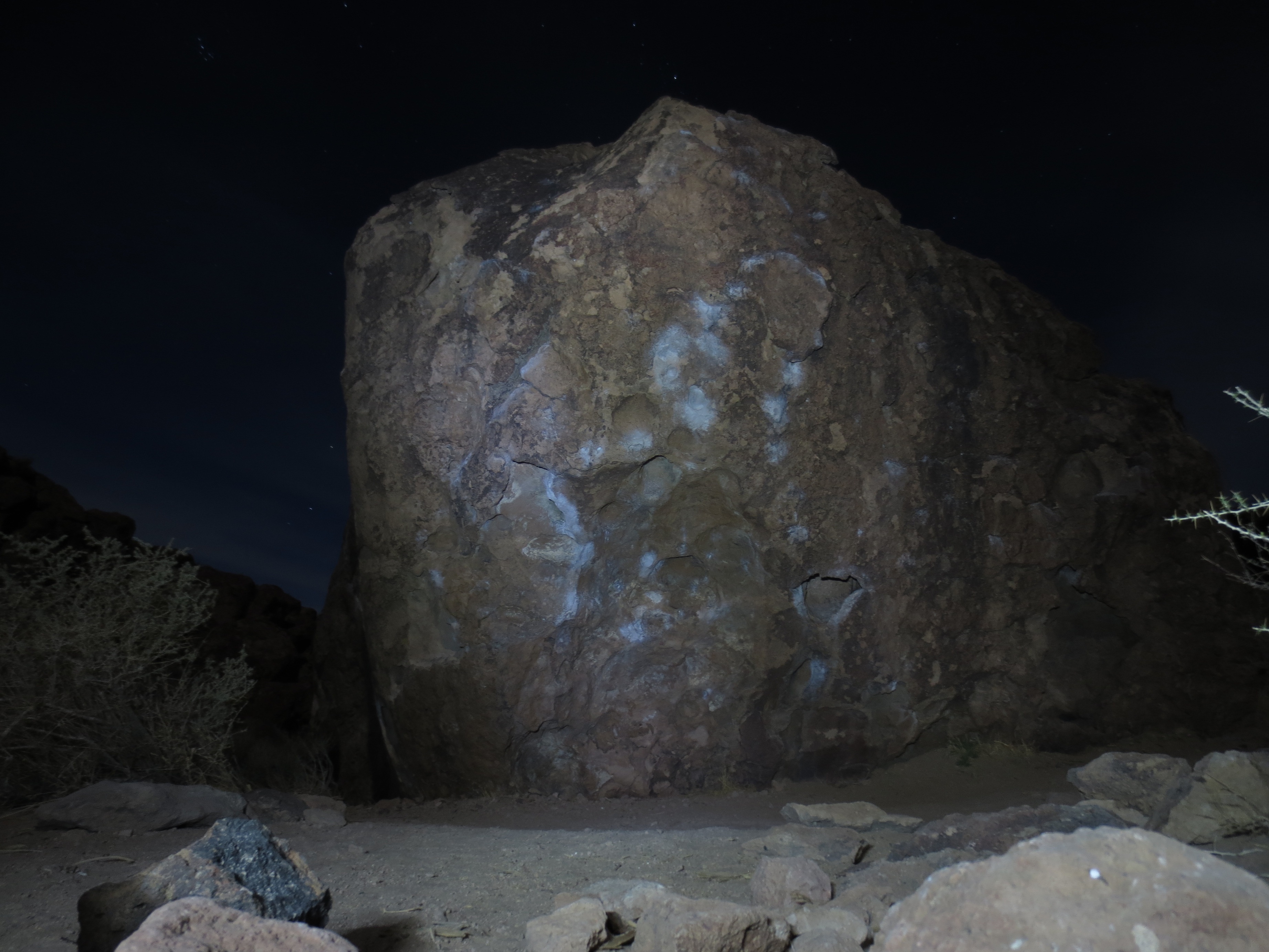
Serengeti at night, lit by my headlamp.
Some things I learned:
– Limiting my total number of burns for a given day is a good idea.
– Being strict about resting in between burns is key to sending.
– Watching others try moves before getting on a problem, and generally examining holds and imagining sequences saves energy and skin.
– I enjoy climbing with precision and elegance, whether I’m on a V0 or a V8. Need to focus more on that.
– Tactics: clean my shoes with a brillo pad, brush holds as much as needed, don’t take any risks with pads. For hard problems that I really want to send, save the all-out burns for when conditions are right. High Plains Drifter had seemed hard in the afternoon sun, and it felt easy in the morning shade with cooler temperatures.
I need to do one or two of these extended road trips every year for as long as I can. I’m all climbed out and don’t want to touch rock for a week, but at the same time these were some of my happiest days in a while.