Author Archives: diego

Road Trip: Bishop – Vegas – Bishop

I was just on the road for twelve days, and too busy to write about it. Eight days of bouldering, lots of skin lost, 1600 miles driven, dozens of people met, fun galore.

Highlights of the trip: High Plains Drifter is the best boulder problem I’ve ever climbed. It seemed to suit my style well, it didn’t take me that many tries.

Another awesome problem I climbed was one in Vegas called The Dirty Rail. Getting there is a bit of a hike, but it’s worth it just for this problem.

I climbed at least one new problem for every grade up to V7. Besides the two above, I really liked The Clapper (V6), Fly Boy Arete (V5), Sleeping Gas and Still Life (both at the Sads, V2), and Good Morning Sunshine (highball v1 at the Buttermilks).

A few to go back to:
– Soul Slinger (V9, Buttermilks). Seems possible, but I’d need perfect conditions and other people to work it with.
– Pow Pow (V8, Sads). Tried it on my last day. It was hot, I couldn’t stick what was the hard move for me: getting the high left heel on without peeling off from the greasy handholds.
– Action Figure (V6, Happies). I shouldn’t have tried it as the last climb of the last day. That two-finger pocket move was a flirt with serious tendon injury. I liked it a lot though.
– Go Granny Ho (V7). Tried it on a supposed “rest day” after High Plains, because people were hanging out there. Doesn’t seem too bad for a seven, and it’s pretty safe. It comes down to a big reach that I need to commit to.
– Molly (V5, Sads). Going to the sads on your last day is not a good idea. I could not find a way to set myself comfortably on the left crimp / sidepull and gave up. I can’t try pockety problems more than two or three times.

I never got to try Fly Boy, Suspended in Silence or Strength in Numbers, all of which look awesome. I need more friends and pads 🙂

I did repeat (trip-flash) two cool classics: Iron Man Traverse (if I lived there I’d go at the end of the days and run laps on it to exhaustion) and Serengeti (came down after giving up on Action Figure to meet a big group of San Diego climbers).
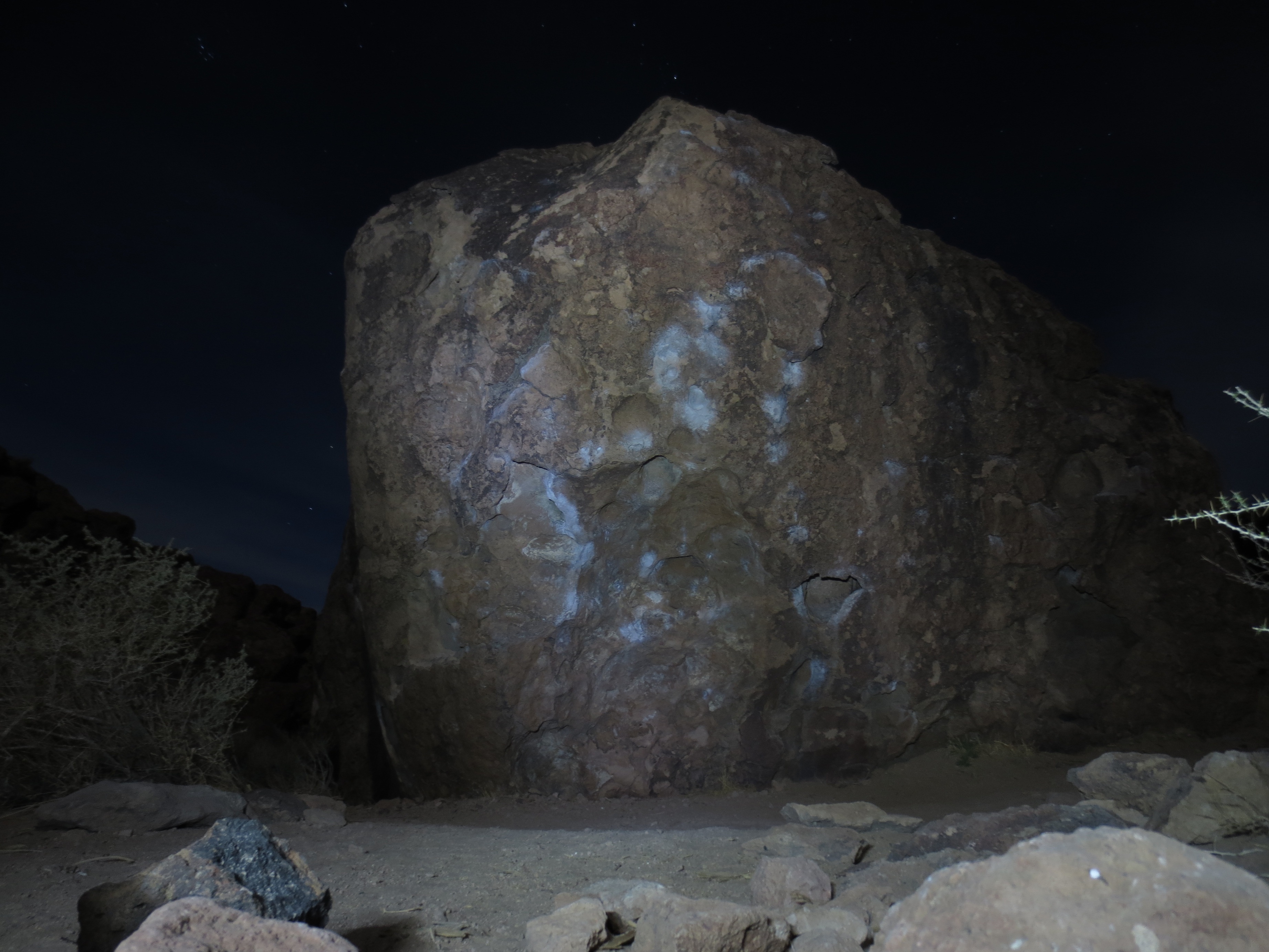
Serengeti

Serengeti at night, lit by my headlamp.

Some things I learned:

– Limiting my total number of burns for a given day is a good idea.
– Being strict about resting in between burns is key to sending.
– Watching others try moves before getting on a problem, and generally examining holds and imagining sequences saves energy and skin.
– I enjoy climbing with precision and elegance, whether I’m on a V0 or a V8. Need to focus more on that.
– Tactics: clean my shoes with a brillo pad, brush holds as much as needed, don’t take any risks with pads. For hard problems that I really want to send, save the all-out burns for when conditions are right. High Plains Drifter had seemed hard in the afternoon sun, and it felt easy in the morning shade with cooler temperatures.

I need to do one or two of these extended road trips every year for as long as I can. I’m all climbed out and don’t want to touch rock for a week, but at the same time these were some of my happiest days in a while.
Balcarce, Argentina

A few days ago I flew down to Buenos Aires to visit my mother and her husband. It’s still the summer here, so I wasn’t expecting to do much climbing. The weather turned out to be pretty mild, high 60s to low 70s so I drove to Balcarce, a small town four hours to the south that has a fair amount of world-class bouldering. There are maybe 500 established problems, and almost infinite potential for more. The rock is extremely gentle on the skin, so you can climb until your tendons cry uncle.

On Thursday I met with a group of locals who were going to Techo Grande (Big Roof), a sector with some of the oldest established problems. That place overlooks a Nascar-style race track, so it attracts people who want to watch the races without paying for admission. Luckily there isn’t any trash around because the local climbers clean it. However, you can see graffiti going back to at least thirty years! Most of the other sectors are secluded and have not been defaced, so they look more like Switzerland.

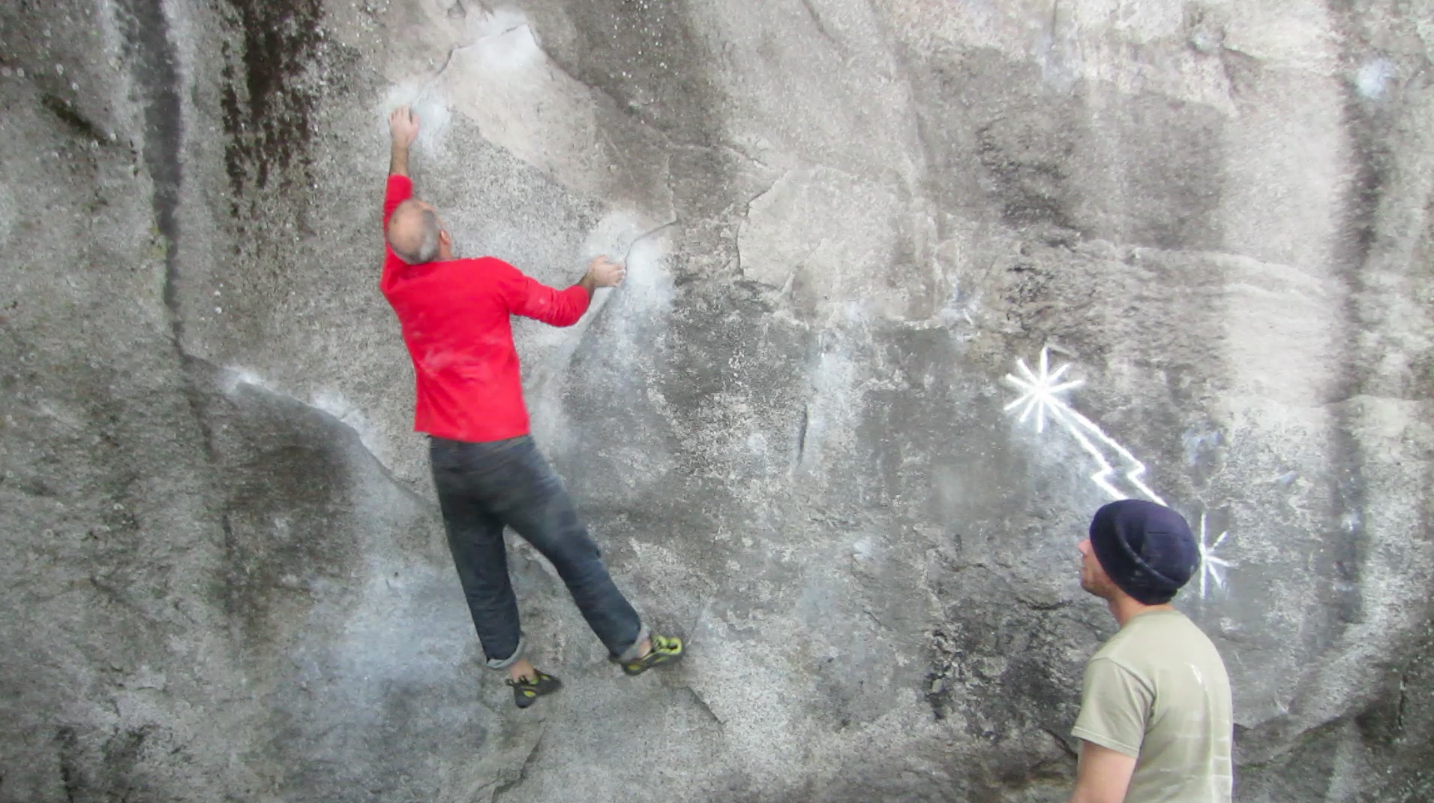
Anyway, the locals wanted to try a problem called Asperix that was first done around 2000. I’d been there before, and never even attempted it because it seemed too hard for me. I gave the stand start (V6) a couple of tries and did it, so I decided to try the sit start that goes at V7. I sent it after a few more tries, and I was super happy:

The next day Juan (a local) and I went to a sector currently under development called La Cabezona (“the big-headed female”). It already has a handful of double-digit problems established by Nicolás Pacheco, a strong climber from Buenos Aires. However, many boulders are still completely untouched. It was raining on and off, so we spent most of our time under a roof. We scrubbed and climbed four new problems between v3 and v5, and left an open project that harder but still in the single digits. I love finding obvious lines that haven’t been climbed, regardless of the difficulty. Here’s one of them: Techo Cubista (Cubist Roof), first ascent 🙂

Nat’s Traverse V8

Mortar Rock in Berkeley is the closest bouldering to my house, at least in terms of driving time outside of rush hour. Until late 2012 I hadn’t spent much time there; the rock is sharp and I’d done all the “easy” problems worth doing. The remaining ones start at v8, and I thought they were impossible for me.

I was talking to a friend at the gym who said I should start working Nat’s Traverse, perhaps the most classic boulder problem in the Bay Area. It’s a long and burly sequence of moves with plenty of options for different body types (none of them easy, of course). It starts around a corner, has a crux move to gain the main wall, then another difficult sequence around a bulge, and then it’s about having enough juice left to go up The Ramp (V4). I thought I’d give it a try. It’s been a relatively dry winter in the Bay Area, so I had plenty of days with great conditions to figure out the moves.

A couple of weeks ago I finally had every single move down, so it was a matter of linking them all together. Last weekend I fell three times on the next-to-last hold of The Ramp, which I’ve done at least a hundred times. Yesterday I managed to fall on the last possible move: I choked and didn’t grab the Cheese Grater hold properly. I wasn’t pumped, so I knew that I could do it. I rested half an hour and finally managed the send.

It’s the first time I climb a relatively long-term project after putting in a number of hours into it, so now I have a glimpse of what it must feel like for those persistent climbers who constantly push their limits. It feels great. On to the next project!

Bishop, February 2013

I went to Bishop again for a couple of days. It was a fun trip and the weather was perfect. I stayed between Wednesday night and Saturday morning, spending two days in the Buttermilk area and one in the Happy Boulders.

What I wanted to climb on this trip was High Plains Drifter (V7) but I caught a cold and wasn’t feeling strong. I fell at the last hard move a couple of times and called it quits. My friend wanted to try Seven Spanish Angels, so we went there and gave it a few good burns. It was getting dark, and I could not commit to the final dynamic move.

I climbed a few easier problems, including a flash of a V5 called “Son of Claudius Rufus” just because it was near the Hulk. It seemed easy to me, I would not have rated it B5. I also climbed some easy highballs just to improve my mental game.

I tried to film a problem called Go Granny Go (V5) at the Grandma Peabody boulder. It’s quite popular because it doesn’t get high off the ground, and it’s almost always in the shade. I couldn’t aim my GoPro camera correctly because it doesn’t have a screen, so you can’t see the jug at the end. A jug is a jug is a jug. Anyway, I have this problem wired so I use it to gauge if I’m feeling strong enough for harder ones.

Some thoughts from this trip just for myself:

1) Never boulder three days in a row, no matter what. After 40 this is flirting with injury, and it’s not even fun.
2) For my next trip to Bishop, go for quantity. Try to get on as many good problems as possible within my ability, and don’t spend many burns on any particular one. Bishop is too long of a drive to have long-term projects, and I can only go there maybe 3-4 times a year.
3) Try to avoid weekends in Bishop during peak bouldering season. The place on Saturday felt like a climbing gym, complete with dogs and screaming babies. At the very least, try to go off the beaten track.

Dogpatch Boulders

There are two main chains of climbing gyms in the San Francisco Bay Area: Touchstone and Planet Granite. Until now Planet Granite in SF has been the best gym for bouldering. This is about to change with the upcoming opening of Dogpatch Boulders.

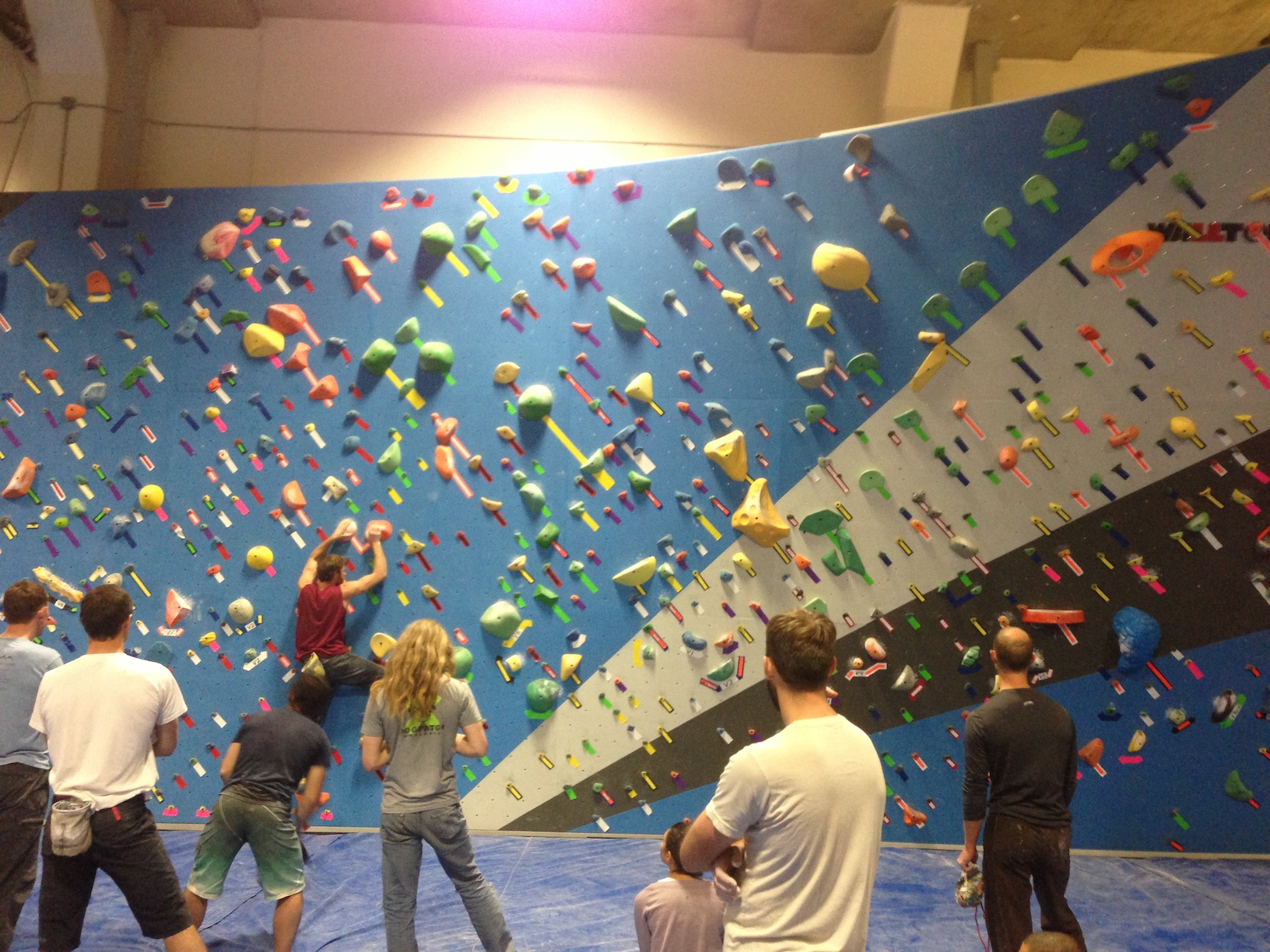
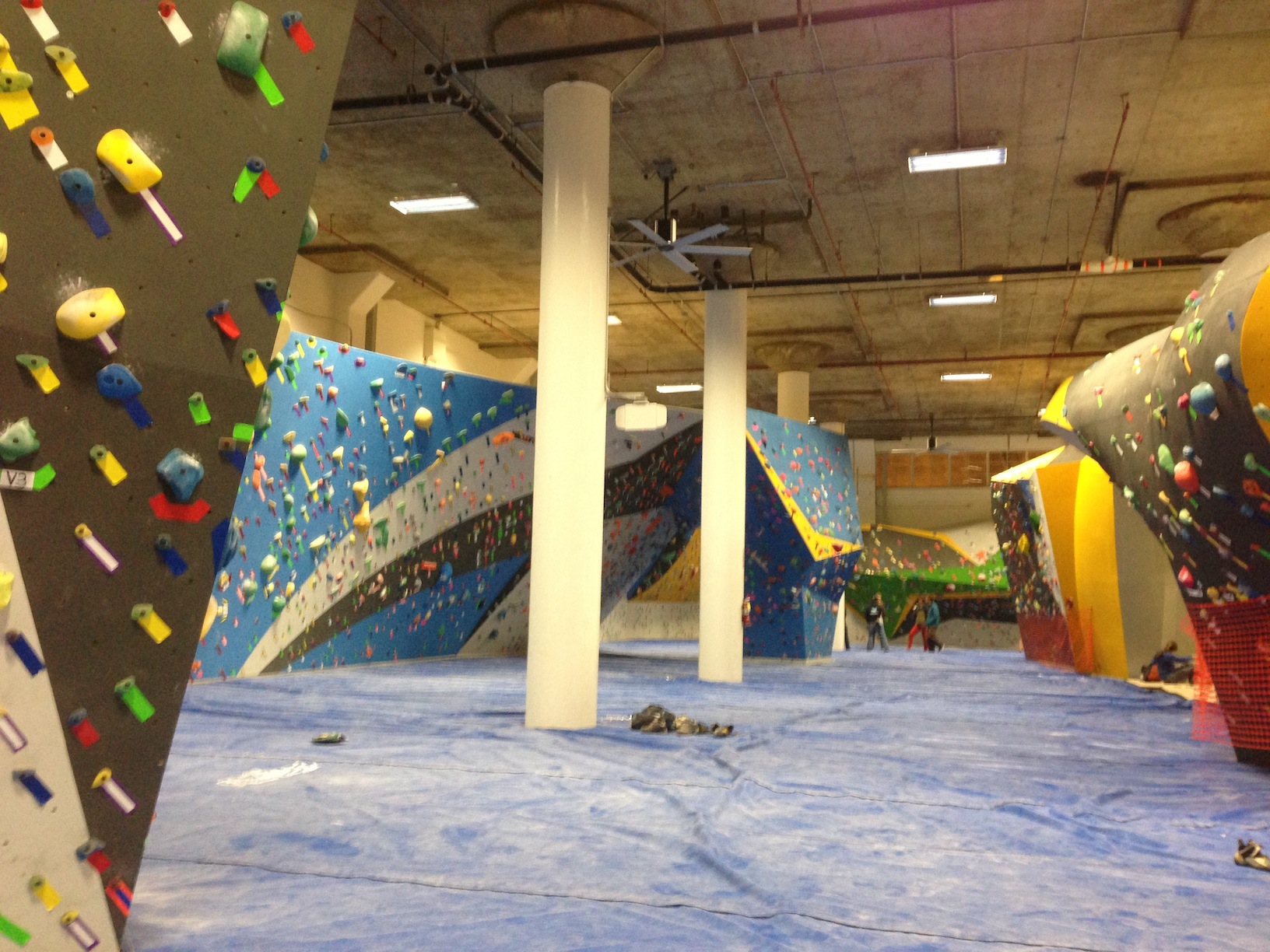
Last night they had a preview climbing session for Touchstone members, announced on Facebook. I do not use Facebook, so I didn’t know. I randomly found out about it when, at the end of my training session, I asked a staff member about the status of Dogpatch. Learning that it was open, I was there ten minutes later. I was able to take advantage of the last hour of the event, and it was just fantastic. I loved the texture of the new holds, the height of the problems, and the thick padding on the floor. Many of the problems I tried were really good. I didn’t rest much during that hour, but still managed to take a couple of pictures. I can’t wait for this place to open officially!

dogpatch2

This is as much of the place as I could get in one picture. There’s more!

dogpatch

Yosemite in Early February

Spent this weekend in Yosemite. The weather was as good as it gets: 30s and 40s, sunny, perfect friction. My main objective was to make some progress on Midnight Lightning, which I did. Still not close to finishing it, but it feels possible.

midnight-lightning-02-2013

I also climbed a few easier problems, of which my favorite was Atlantis. It would have been even better if some key holds hadn’t been soaked and dripping. I avoided grabbing the left side of the rail, but for the next move I had to step on it with my entire sole. When I got to the top my shoes were wet and I was stepping on ice. That was exciting. I imagine that when it’s dry it must feel easy for the grade.

Another cool problem at Camp 4, called Hit Man. Tried with a few other people. It took us a while to figure out the moves, then it seemed relatively easy.

There were not very many people around, perhaps because it was the Superbowl weekend. That made it even better. I don’t like being in Yosemite when it’s crowded, so I’ll try to take advantage of good weather in the next couple of months. Hopefully there will be a few more weekends like this one.

Bishop, Perfect Weather

I drove from SF to Bishop yesterday. Seven and a half hours on the road, Taco Bell for dinner, good coffee for breakfast today at the Looney Bean. It was a bit cold in the morning, but I knew it would be perfect later. I went to the Happy Boulders, where the first thing I did was try a problem that seemed hard the last time I was here (Every Color You Are, V6). It wasn’t quite a warm-up, but it felt easy. Check out the video:

Encouraged by that I went on to try harder things, no success so far. I’m in my forties and I still haven’t learned to pace myself. We’ll see if I have anything left for tomorrow 🙂

My Anti-gravity, Leave-no-trace Hangboard Setup

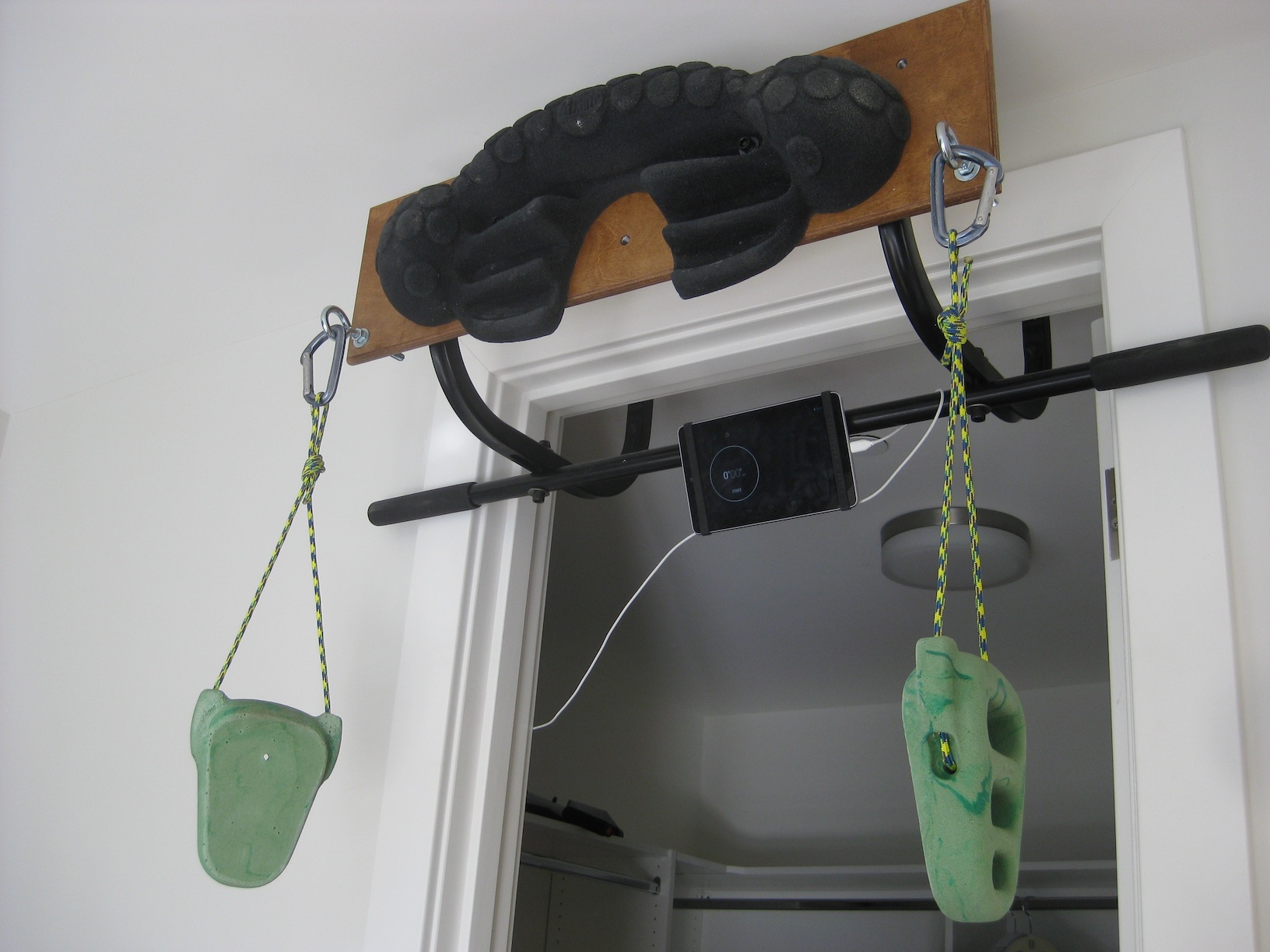
A few weeks ago I decided to start a periodized training cycle. The first phase would be hypertrophy, for which a hangboard is a key component. I have the Blank Slate Slim training board with a couple of hangboards that I swap. The one in the picture is the Kraken:

hangboard1

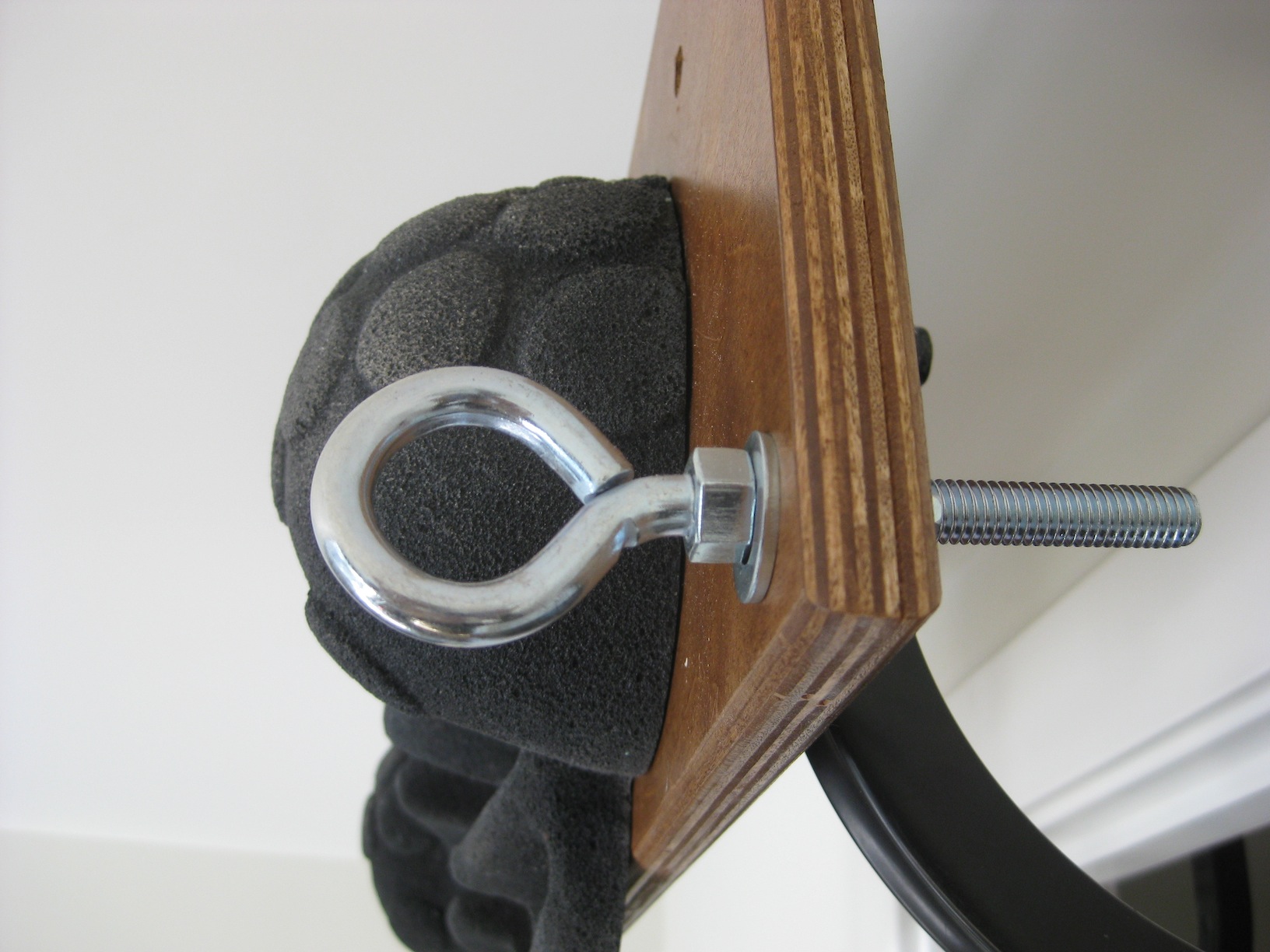
Observe the Metolius Rock Rings hanging from two 3/8″ by 4″ eye bolts, each one rated to hold 350 lbs.

hangboard2

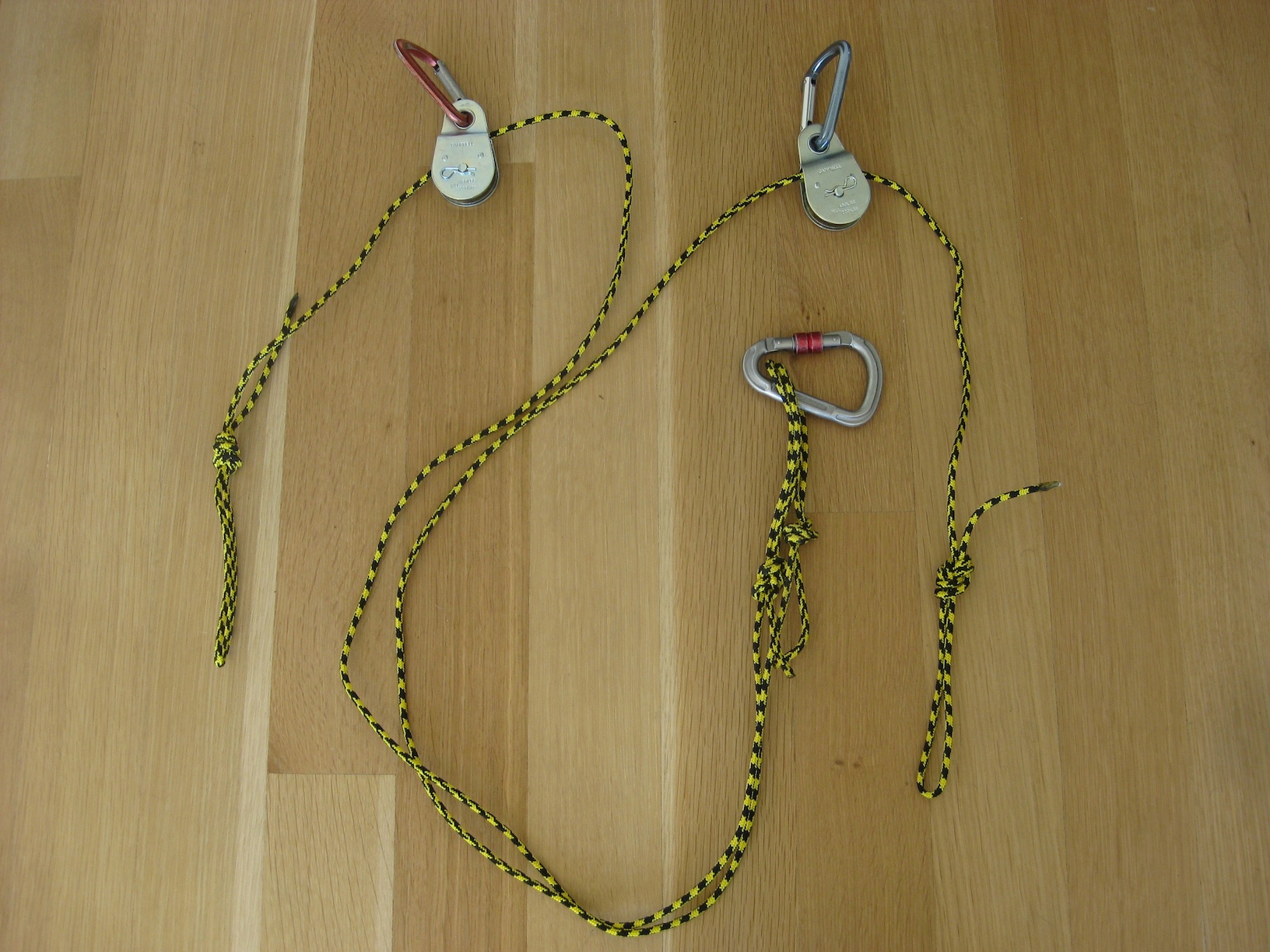
One of the problems with hangboard training is that some grips are too easy and others are too hard. When using four fingers I can hang for too long, and with two usually not long enough. The solution to this problem is to make yourself heavier or lighter so that you can hang from a given grip for the right amount of time before having to let go. The heavier part is easy: just hang some weights from a harness, or use a weighted vest if you have one. Making yourself lighter is nontrivial, so I concocted this rig:

hangboard3

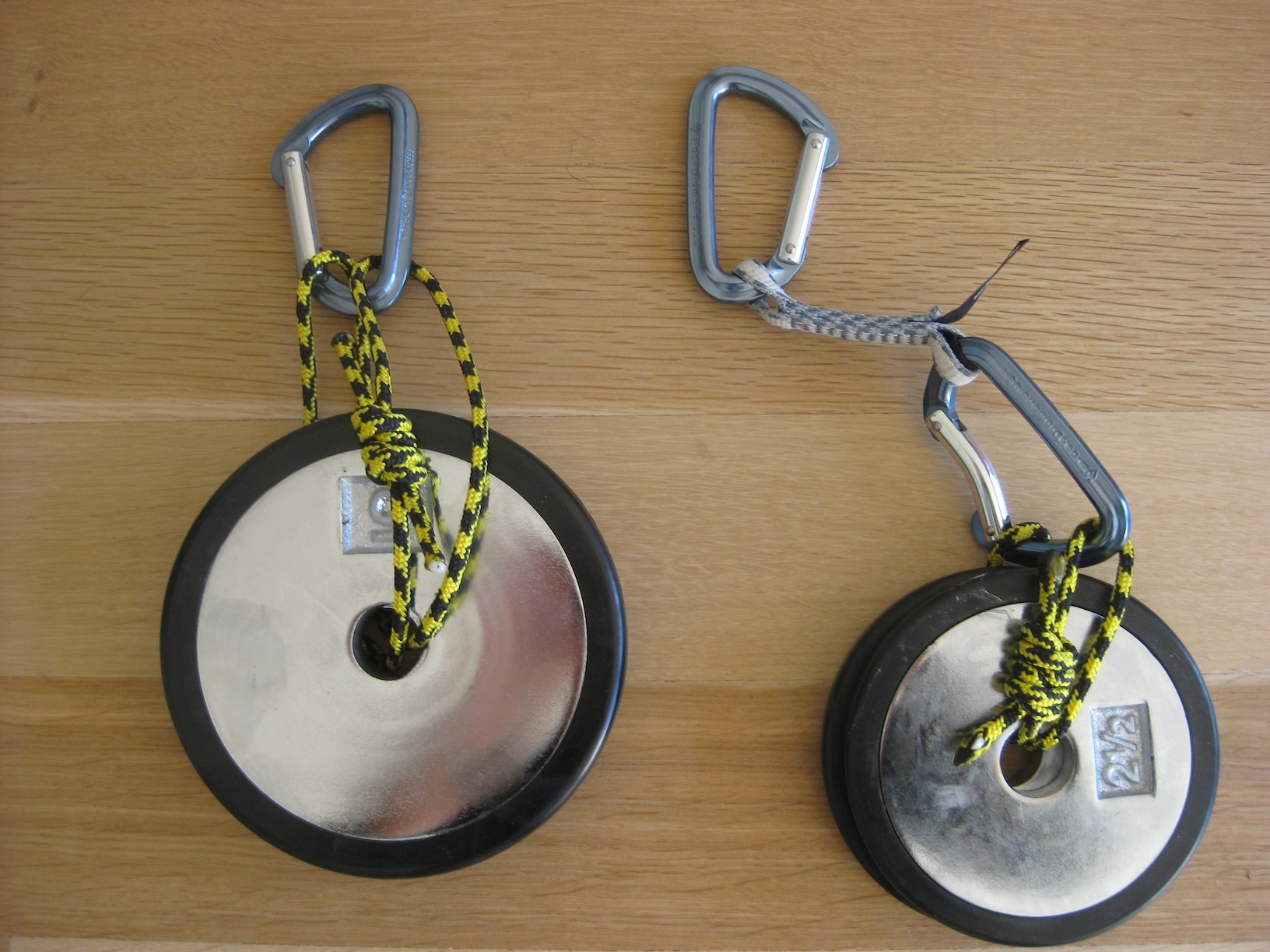
This is a system of two pulleys attached to some 8mm accessory cord and carabiners. I had everything but the pulleys, and I could have connected the cord directly to two or three biners. The weight probably would never be enough to wear the biners significantly by cord friction (30 lbs on each side at most). Still, why not spend a few bucks on a pair of nice pulleys to reduce friction. I also had a set of adjustable dumbbells with removable plates adding up to 50 lbs. I attached them to biners with prusik loops, so I can remove them easily.

hangboard4

This is what the right looks like with 20 lbs (10 on each side) attached to my harness:

hangboard5

Notice the tablet with the timer ready to go. This is crucial for hangboard workouts.

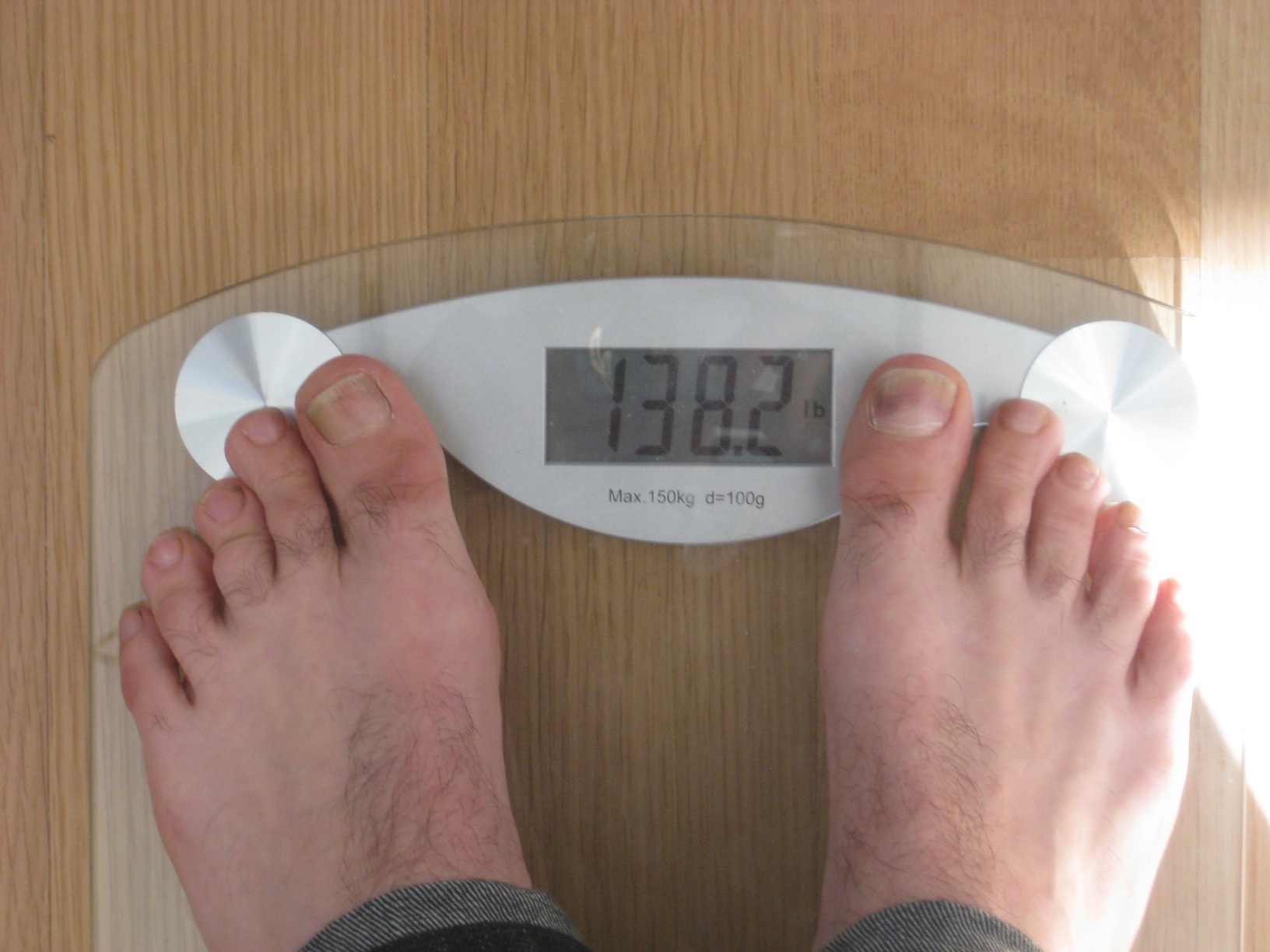
So how much lighter does this make me? Before:

hangboard6

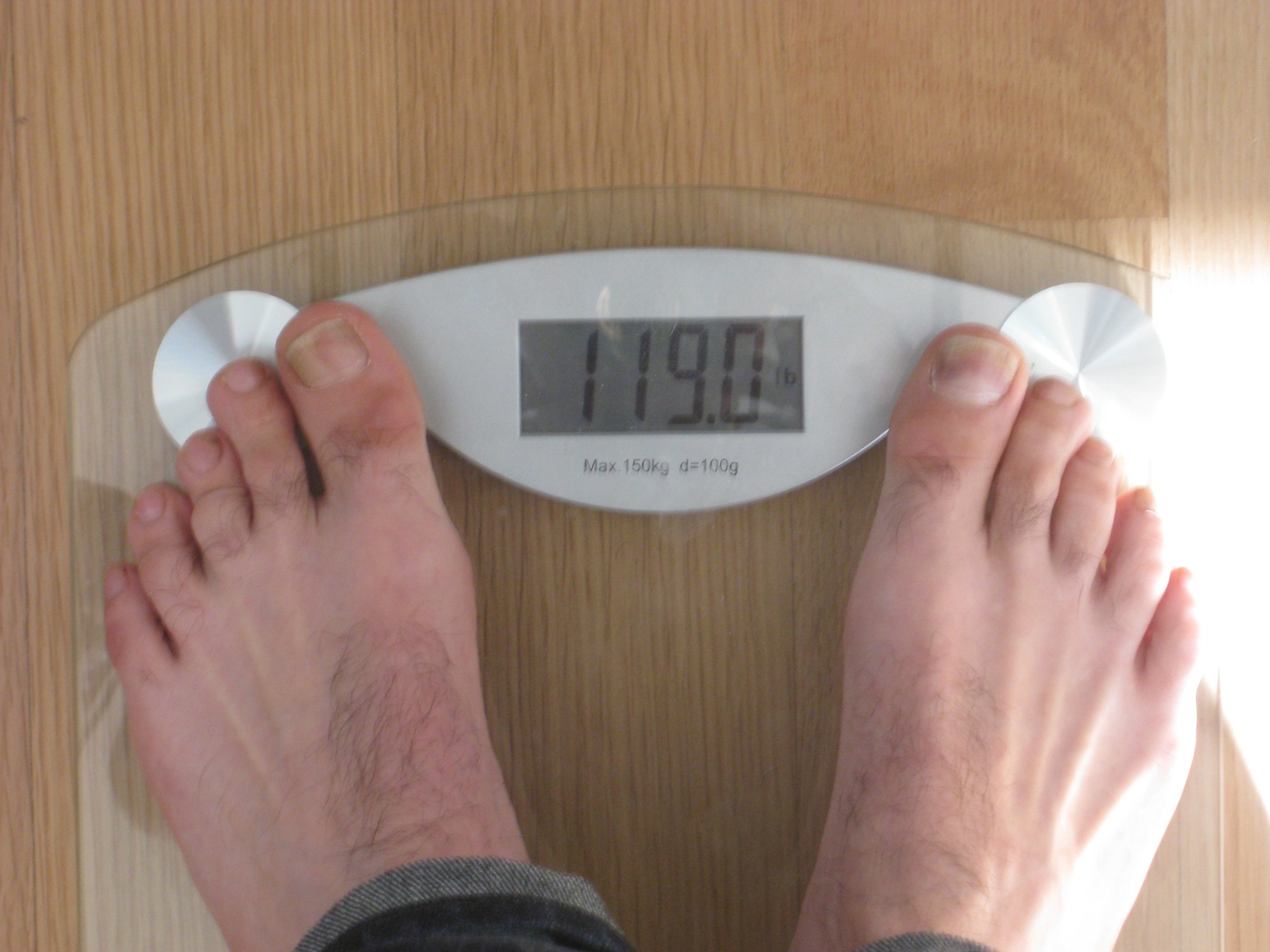
After: hangboard7

Not bad, barely one pound is lost between friction and and the components of the forces that offset each other pulling me slightly toward the sides. The important thing is that I can remove a consistent amount of weight. After experimenting a bit, I know that if I somehow weighed 100 lbs and my arm strength remained the same, I could easily do many one-armed pull-ups 🙂

The best thing about this setup is that you can put it up in an apartment, and move it easily without leaving any marks. The extra hardware wasn’t that expensive: less than $20 for the bolts and pulleys. I had the weights already, but you could use bags filled with rocks, sand, whatever.

Hope this is useful. Enjoy and get strong!

Warm Up Post

I first started rock climbing twenty years ago. Back then it was an adventure sport. The objective was getting to the top of a multi-pitch route without falling. Sport climbing was mocked. I didn’t even know bouldering existed. There was no training. I gave up after a year because it seemed too dangerous.

I started climbing again in 2005, and this time I was hooked. Gear and safety standards had improved, and it didn’t seem so risky. Climbing at the gym was fun and social, a great way to decompress after work. I did easy trad for a while, then got into harder sport, and for the past three years I’ve been mostly bouldering. I live in San Francisco, which is an excellent city in that respect: at least a dozen different bouldering spots less than an hour away. Some places such as Mortar Rock in Berkeley have no approach: you can park next to the boulders for a quick session, then go get a cup of coffee at the Starbucks down the street. Others, like Castle Rock, can feel remote and secluded on a random weekday.

I’m 43 years old now, and I’ve reached a plateau of sorts. I’ve been bouldering more or less at the same grade for about two years. I don’t have a fulltime job these days, so I have a lot of time on my hands. This year I decided to start training more methodically to see how far I can get. I have some very specific objectives, and I will share them in due time. I’ll also share my progress, trip reports, videos of climbs, training tips, and whatever else I feel like.

Climbing is one of those activities that has no goal other than personal enjoyment. It’s not much of a spectator sport. You can play your guitar to entertain your friends, but bouldering isn’t so easy to share. Perhaps that’s why I’m writing this: to share it with an imaginary audience (I don’t really expect many eyes to see these posts).

Ok, I’m warmed up. My next post will be about something very tangible. Until then!